 AppVerz
Blog / 9 November 2026
Slack is 312 MB. Stackyard is 9. What native Mac software buys you, and what it costs
We measured our three apps against two familiar ones on the same Mac. Why SweepyMac, FocusLens and Stackyard fit in 35 MB between them, what building only for the Mac gets you, and what we gave up in exchange.
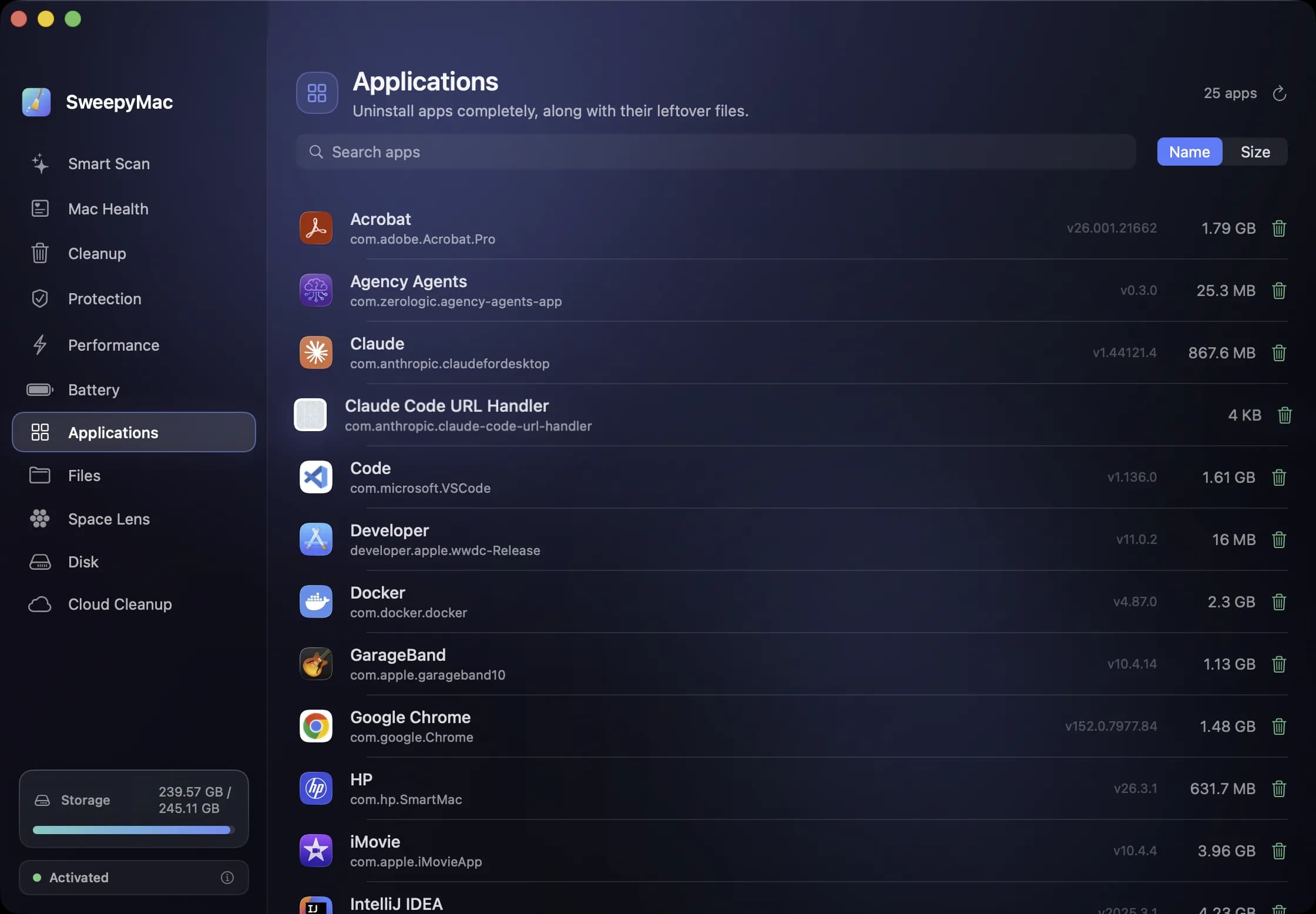
Here is what du -sh reported for five apps installed on the Mac this post was written on, in November 2026.
| App | Version | Size on disk |
|---|---|---|
| Visual Studio Code | 1.145 | 1.5 GB |
| Slack | 4.51 | 312 MB |
| SweepyMac | 1.0.2 | 18 MB |
| Stackyard | 1.0.3 | 9.0 MB |
| FocusLens | 1.0.1 | 8.4 MB |
All three of ours add up to about 35 MB. The disk images you actually download are smaller again, at 5.5, 3.9 and 4.4 MB. You can check any of this on your own Mac, and you should, since all it takes is one line in Terminal.
This is not us saying Slack is badly made. It is about what a decision does to an app's size, and the fact that it comes with a bill.
Where the difference comes from
Inside Slack's bundle there is a folder called Electron Framework.framework, and it takes up 274 MB of the 312. Electron is a way to build a desktop app out of web technology, and it works by bringing its own copy of Chromium. Every Electron app you install carries a web browser with it, and your Mac keeps a separate copy for each one.
Our three apps link against SwiftUI and AppKit, which macOS already has. There is no framework to carry, because you already own it. Open any of the three bundles and the only thing in the Frameworks folder is Sparkle, the open-source updater used by a lot of Mac apps, at 2.7 MB. The rest is the app itself.
SweepyMac is the heaviest of the three at 18 MB, mostly its program code, because it is really eleven tools in one window.
Why Electron is often the right choice
It would be easy to stop there, and it would be misleading. A company that has to ship on Mac, Windows, Linux and the web has every reason to write it once. Visual Studio Code is an enormous, excellent product with an extension ecosystem we could not begin to match, and its size is the price of being what it is. Those teams made a sensible decision for their situation.
We made a different one, for a different situation: three small utilities, on one platform.
What native gets you
Less to install and less to trust. A smaller bundle has less in it, and the fewer third-party components an app includes, the fewer things can go wrong or need patching. FocusLens's only third-party code is Sparkle.
A real macOS citizen. Keyboard shortcuts, menu-bar items, widgets, light and dark appearance and system notifications come from the platform. Stackyard lives in your menu bar and FocusLens has three sizes of widget because that is what Mac apps do.
Access to what the system knows. FocusLens tracks your day by listening for the same app-activation notifications the Dock uses, which is why it needs no permission at all to begin. Stackyard reads processes, ports and thermals directly. SweepyMac reads your battery's condition straight from macOS.
Small apps that deal with bloat. It would be strange for an app that frees your disk to take up a noticeable amount of it, or for one that hunts memory hogs to be one.
If you would like a measurement we did not make, install Stackyard, open its Memory section and compare the rows yourself. Each app's helper processes are folded under it, so an Electron app shows as a single honest number.
What it costs us, and you
There are real downsides, and you should know them before you buy.
Mac only. If you also use a Windows PC at work, none of these will follow you there. A Windows version would be a different app written from the start.
macOS 14 or later. Because we lean on the system's frameworks, an older Mac that cannot run Sonoma cannot run these. An Electron app bringing its own runtime is much less fussy about that.
One small team's pace. Writing natively for one platform means we have only one platform to look after, and support gets answered by the person who built the app. It also means there are features a large company would have added by now.
No App Store for Stackyard. Quitting other apps requires leaving the sandbox, and the App Store takes only sandboxed apps, so it is a signed, notarized download from us.
The three, in case you are curious
- SweepyMac cleans a full or tired Mac, and everything it removes goes to the Trash first. From $14.99 a year, or $59.96 once.
- FocusLens shows where your attention actually went, with no account and no permission to track. $19.99, once.
- Stackyard runs a developer's Mac from the menu bar. From $21, once.
Each is free for three days with no account, and if you are not sure which fits, there is a short guide to choosing.
Questions people ask
- Are SweepyMac, FocusLens and Stackyard built with Electron?
- No. All three are native Mac apps that use SwiftUI and AppKit, which are already part of macOS. The only framework bundled inside each is Sparkle, the open-source updater.
- Will they ever come to Windows or Linux?
- They are built on Mac-only frameworks and on Mac-specific behaviour, so a Windows or Linux version would be a separate app rather than a port. Today all three are Mac only.
- Why do they need macOS 14?
- Because they rely on the system's frameworks instead of shipping their own. It is the cost of the small size: all three need macOS 14 Sonoma or later.
Related reading
- SweepyMac, FocusLens or Stackyard: which one do you actually need?Three Mac apps from one small studio, each for a different problem. A cleaner for a full or tired Mac, an attention tracker for a day that vanished, and a menu-bar tool for a developer's machine. Who each one is for, what it costs, and when you need more than one.
- Why our apps send nothing home, and what they do fetchFocusLens and SweepyMac send nothing about how you use them. FocusLens only checks its licence and looks for updates; SweepyMac also fetches a signed malware definitions file. Here is what no telemetry means in practice, what we give up for it, and how you can check the claim yourself.
- What is System Data on a Mac, and how much of it can you get back?System Data is a catch-all, not a thing you can open. What usually fills it, which parts macOS will clear by itself, which parts are safe for you to remove, and which ones a cleaner should refuse to touch.
Have a question about any of this?
Write in. The person who built the apps reads every message and replies within two working days.