 AppVerz
Blog / 9 November 2026
Four workdays, four focus scores, and what each one is telling you
A day of meetings can outscore a day of real but scattered work, and one misfiled app can cost 40 points. Four worked examples using the actual FocusLens formula, and the one thing to change after each.
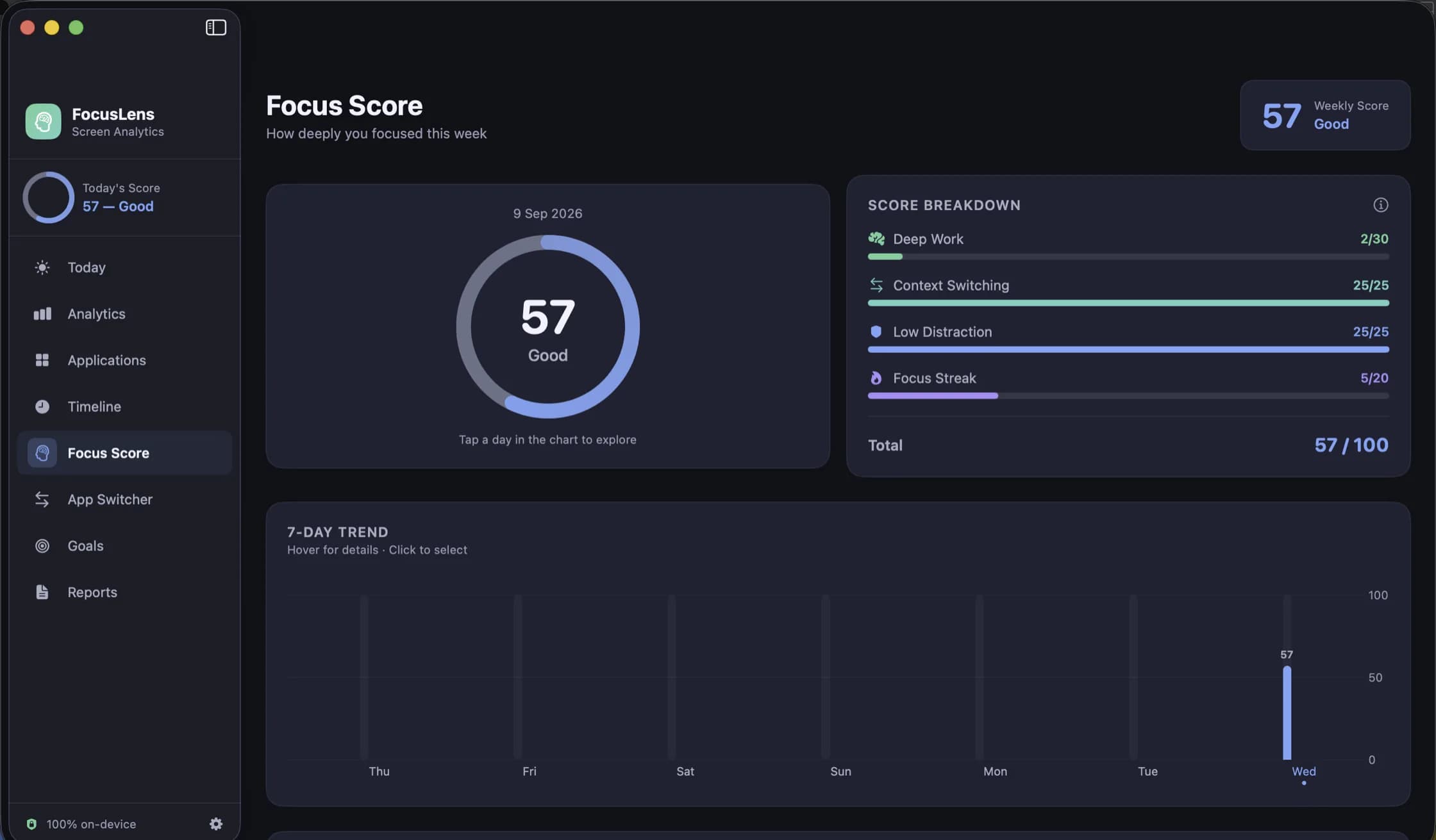
Here is a day that scored 63: one and a half hours of real work, surrounded by meetings. And here is one that scored 54: five hours of real work, in pieces. If you only looked at the number, you would conclude that the meeting day was better.
A focus score is only useful if you can read it. We took the parts apart in another post. This one runs four invented but realistic days through the formula the app actually uses, so you can recognise your own.
The formula, in four lines
- Deep work, 30 points. Productive hours divided by six, times 30. Full marks at six hours.
- Context switching, 25 points. Starts at 25. The first five switches each day into a distracting or entertainment app are free, and each one after that costs 1.5 points.
- Low distraction, 25 points. The share of your tracked time that was not spent in distracting or entertainment apps.
- Focus streak, 20 points. Your longest unbroken productive run, with full marks at two hours. A gap of up to five minutes does not break a run, but a switch into a distraction does.
Fractions round down. The labels run Needs Work below 40, Fair from 40, Good from 55, Great from 70 and Excellent from 85.
Day one: the maker's day
Six productive hours, a longest run of two hours, three switches into distractions, and twenty minutes of distraction in a seven-hour day.
| Part | Points |
|---|---|
| Deep work | 30 of 30 |
| Context switching | 25 of 25 |
| Low distraction | 23 of 25 |
| Focus streak | 20 of 20 |
| Total | 98, Excellent |
What to change: nothing. Do look at what made it possible, though, because those conditions are worth reproducing on purpose. Open the Timeline and see what your morning looked like. Also notice that six hours gets full marks. A seventh earns no more, and we built it that way so the app would not cheer for overwork.
Day two: the day of meetings
Eight hours at the Mac. An hour and a half of productive work, a longest run of 40 minutes, four switches into distractions, and no distraction time to speak of. The rest is video calls and mail.
| Part | Points |
|---|---|
| Deep work | 7 of 30 |
| Context switching | 25 of 25 |
| Low distraction | 25 of 25 |
| Focus streak | 6 of 20 |
| Total | 63, Good |
This is the score people find surprising. FocusLens files calls and mail as communication, and communication is not a distraction, so two of the four parts stay full. You were not distracted. You just did not make anything.
What to change: if meetings are your job, then 63 is a good day, and you should stop comparing it with a maker's day. If they are getting in the way of your job, look at deep work alone across the week. Seven out of thirty on four days out of five is a calendar problem, and it is now a number you can show someone.
Day three: the scattered day
Five productive hours, which is plenty. But the longest run is only 25 minutes, there are nineteen switches into distractions, and an hour of an eight-hour day went on distracting apps.
| Part | Points |
|---|---|
| Deep work | 25 of 30 |
| Context switching | 4 of 25 |
| Low distraction | 21 of 25 |
| Focus streak | 4 of 20 |
| Total | 54, Fair |
Five hours of work, and it scores below the meeting day. That is the score doing its job: the same hours are worth less when they arrive in 25-minute pieces.
What to change: open the App Switcher. Worst Offenders names the apps responsible and Switch Chains shows the bursts. Usually one app is doing most of the damage. Getting from nineteen switches to eleven earns 12 points by itself, and the streak will tend to rise with it, because a switch into a distraction is exactly what ends a run. Set a limit on the distracting category in Goals and let the alert tell you when you hit it.
Day four: the day that was filed wrong
A writer spends five hours in a drafting app that FocusLens has never heard of, so it lands in Neutral. Their longest run is ninety minutes, with two switches into distractions.
| Part | Filed as Neutral | Filed as Productive |
|---|---|---|
| Deep work | 0 | 25 |
| Context switching | 25 | 25 |
| Low distraction | 25 | 25 |
| Focus streak | 0 | 15 |
| Total | 50, Fair | 90, Excellent |
Same day and same person, with a 40-point difference from a single setting. If your score feels wrong day after day, and deep work and streak both sit near zero, this is the first thing to check.
What to change: Settings › App Categories › Manage. Search for the app, choose Productive, and every past day recalculates. It takes less time than reading this section.
Using this on your own days
Look at which part is low, then match it up:
- Deep work and streak both near zero, the rest full. Either your main app is misfiled or you spent the day in meetings. The Timeline will tell you which.
- Deep work fine, streak and switching low. You have the hours but not the runs. Go after one interrupting app.
- Low distraction falling. That one is plain enough.
- Everything high. Write down what you did.
Do not compare your score with anyone else's. A manager's 63 and a programmer's 63 are different days. Compare yourself with last Tuesday.
FocusLens does this on your Mac, with no account and no permission to track. It is free for three days, then $19.99, once. Download it and see which of these four you have been having.
Questions people ask
- Do meetings hurt my focus score?
- Only indirectly. Video calls and chat count as communication, which is neither productive nor distracting, so they do not lower the switching or distraction parts. They just leave fewer hours for deep work and streaks.
- Does switching from my editor to Slack cost points?
- No. Only switches into a distracting or entertainment app count against the score, and the first five of those each day are free. Moving between work apps and communication apps is not penalised.
- Does working longer raise my score?
- Only up to a point. The deep work part reaches its full 30 points at six productive hours and the streak part reaches its full 20 at two unbroken hours. A twelve-hour day earns nothing extra for hours seven to twelve.
Related reading
- How to find your peak focus window, and test whether it is realFocusLens can name the hours you do your best work. That chart shows when you did focus, which is not always when you could. A two-week method for finding your window, separating it from your calendar, and proving it by moving your hardest task.
- Studying on a Mac: using FocusLens through exam seasonYour study time is spread across PDFs, notes and a browser that also contains everything else. How to set FocusLens up so its numbers mean something to a student, including the two-browser trick, and what it will never be able to see.
- FocusLens is half price: $19.99 once, and what that buysFocusLens is $19.99 instead of $39.98, a one-time licence with no subscription. What the app does for that price, from permission-free tracking and a focus score you can take apart to replayable days and exportable reports, and how to try it first.
Have a question about any of this?
Write in. The person who built the apps reads every message and replies within two working days.